
Human Computers : Une histoire de l’Informatique Laborieuse. Suivi de Six protocoles d’autodéfense, by the artistic collective RYBN.ORG. Published by Les Éditions UV.
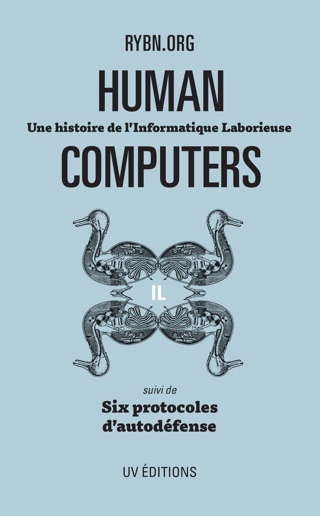 Since 2013, RYBN.ORG has been investigating the phenomenon of ‘Labour-Intensive Computing’, the (often covert) ways Artificial Intelligence and computational processes incorporate human labour and experiment with new forms of work management.
Using the organisation of labour as a critical lens, the artists seek to untangle the intricate web that binds computing to capitalism. Their hypothesis is that human labour, far from being obsolete, remains firmly at the heart of automatised processes, from Gaspard de Prony’s first calculating “machine” in 1793 to today’s large language models.
I loved Human Computers and hope it will eventually be translated into English. We would all benefit from perspectives on technology that move beyond the familiar English-speaking, US- and UK-centred narratives. That perspective does not have to be French, of course. I would equally welcome Mexican, Russian, German or Indian viewpoints. After all, the development of technology has always been a global endeavour.
Back to the book! The topic of “laborious computing” is rather daunting. Yet, the book makes for a perfectly pleasant read: the language is lively, the artistic angle is grounded in in-depth research, the visual material is compelling. The anecdotes and lesser-known historical figures are equally fascinating. Even better, after their expose on labour-intensive computing, the authors give us “Six Protocols of Permacomputational Self-Defence Against Labour-Intensive Computing” that counterbalance the grandiloquent discourse about AI with a toolkit of experiments aimed at breaking away from AI, by challenging its extractivist geopolitics, algorithmic logic, technolanguage and reductionist forms of learning.
RYBN’s chapters follow Amazon’s famous triptych: Work hard. Have Fun. Make History.
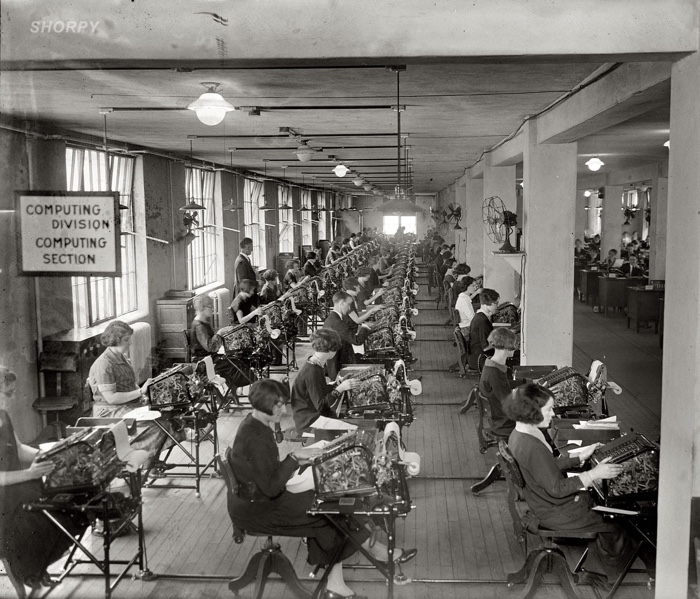
November 24, 1924. Washington, D.C. “Bonus Bureau, Computing Division. Many clerks figure the amount of the bonus each veteran is entitled to.”
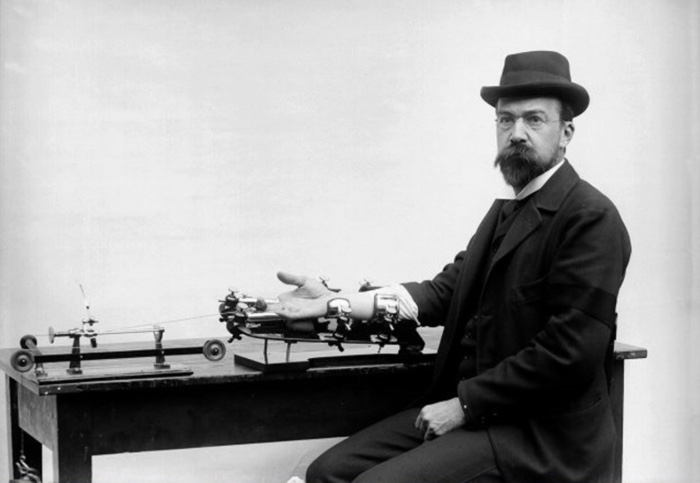
Angelo Mosso with his ergograph, an instrument used to plot an ergogram, that is, the fatigue curve of a muscle. Photo ASTUT
Work Hard explores the history of work within computing processes, tracing the trajectories and eventual convergence of two major developments: the evolution of computational processes and the industrial revolution’s drive to “rationalise” work through the measurement and optimisation of human performance.
The story starts in 1793, when the first mechanised “computers” appeared in Gaspard de Prony‘s computing factory. The French engineer’s key contribution to the history of computing lay in his organisation of computation. Drawing on Adam Smith’s theory of the division of labour, de Prony broke down complex calculations used in geographic surveying into simple, distinct tasks, which he assigned to teams of human “computers.” Each worker performed around a thousand sums and subtraction problems. The work was so repetitive and simplified, it almost transformed humans into machines. Due to the high rate of errors, de Prony’s system was short-lived but it introduced foundational ideas like the division of labour, algorithms and parallel processing, which later informed the work of Charles Babbage and other pioneers of computing.
Another figure I discovered in this chapter is Jules Amar. In his efforts to optimise industrial society, the author of The Performance of the Human Machine: Research on Work (1909) proposed classifying individuals according to their intelligence and personal characteristics. The result, he thought, would help to identify those best suited for efficient labour and those deemed slower or less productive.
Between 1810 and 1950, scientific activity expanded rapidly, bringing with it a growing demand for human calculators, particularly in astronomy, meteorology, and, by the early 20th century, the military. The profession became increasingly feminised, largely because women could be paid less.
At the same time, scientists and industrialists obsessed with optimisation began to treat humans as “animated engines” to be regulated and improved. Throughout the 19th century, they started developing instruments to measure workers’ performance: their energy expenditure, ideal nutritional intake, even the speed of thought. Fatigue was identified as the primary obstacle to efficiency, the enemy to crush. In the second half of the century, savants also tried to calculate mental efforts and intelligence.
These two genealogies (the computing factory and the science of work metrics) converge in the early 21 century with the rise of algorithmic management. As some of Amazon’s patents have demonstrated, the new system can take on dystopian dimensions. Its aim is less to replace humans with machines than to transform humans into machine-like components within a larger computational system.
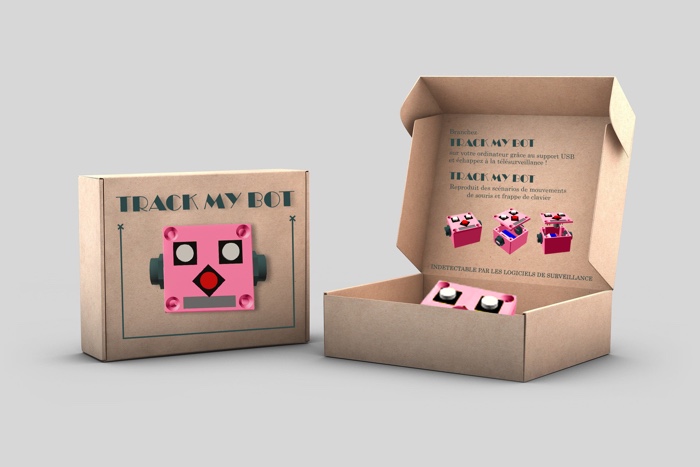
b01, Track My Bot. Part of Telecommuters, an invitation to artists to develop technological tools to deceive surveillance systems
The chapter Have Fun sheds light on the invisibilisation of humans within machines, tracing a history of simulacra, from the animated mechanisms that imitate the living such as Jacques de Vaucanson’s Digesting Duck and Wolfgang von Kempelen’s Mechanical Turk in the !8th century up to CAPTCHAs and the so-called AI-powered services that, in reality, rely heavily on human labour to perform tasks, fill gaps or correct outputs. Across these centuries runs a persistent thread: automatons are often associated with deception. Frequently for good reason.
Make History examines how technoscience builds its own narrative using a kind of Newspeak that renders critique of AI difficult to articulate. In that Newspeak, labour becomes “gamification”, humans performing menial cognitive tasks are turkers, employees are requesters and salaries are rewards. This linguistic shift unfolds within a broader imaginary shaped by metaphors such as “the cloud” and “immateriality,” which obscure a sinister reality of extractivism, ecocide and energy-intensive infrastructures.
To counterbalance the near-totalitarian emprise that technology has on us, RYBN.org propose six protocols of self-defence. These range from opening the black boxes of digital devices to examine the human and ecological costs of their production and disposal; to experimenting with platform labour (such as working as a Mechanical Turk) while imagining forms of resistance; to mapping the Newspeak vocabulary of the tech industry and replacing it with terms that reintroduce critique and challenge its technopositivist, solutionist and colonial imaginaries.
The book details all the instructions and resources needed to reproduce the protocols in a classroom or at home. None of them require a degree in computer engineering or any sophisticated tools. In fact, one can be carried out with nothing more than paper and crayons.
Responding to the need to reclaim and critically reshape the vocabulary used to describe what we now call AI, Francis Hunger closes the book with an essay (a translation in French of his article ‘Unhype Artificial’) that proposes an alternative terminology that seeks to de-anthropomorphise the technology and break its persistent association with human intelligence.
Also by RYBN: ALGOFFSHORE. The Art of Automating Tax Evasion; THE GREAT OFFSHORE; Tax Havens: Normalized Grand Theft, etc.