
All About U.S. 250 Years of the United States of America, by architect, writer and curator Theo Deutinger. Published by Lars Müller Publishers.
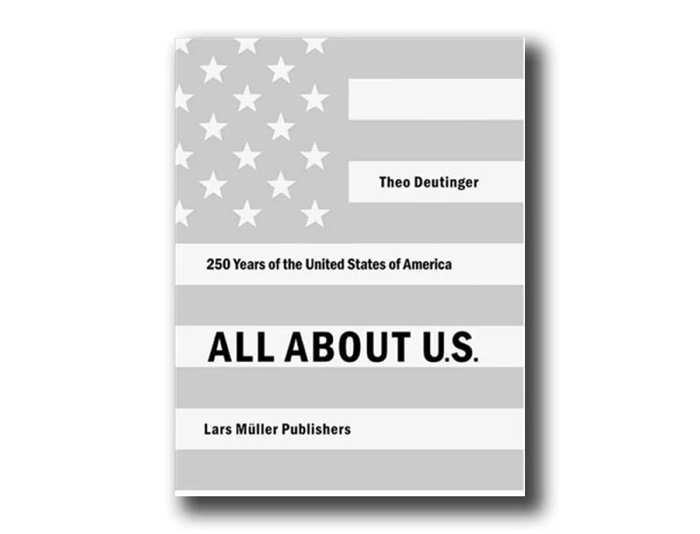
I don’t think I would have been tempted to open the book if it had been covered in “Republican Red” and “Lincoln Memorial pool Blue”. White and grey was a smart move. It gives nuances, subtlety, anything but the brashness of the current POTUS. Now that I think of it, his name and even his existence are mostly alluded to rather than directly mentioned in the book. That alone is quite an achievement.
Nor do I think I would have been tempted to open it if it had not be authored by Theo Deutinger. The architect, illustrator and academic conceived the book as a birthday gift from Europe to the U.S. A European perspective on the country at a moment when the U.S. is bullying and alienating its long-standing allies, waging new wars and leaving much of the rest of the world to deal with the consequences.

Theo Deutinger, A composite of U.S. state flags

Theo Deutinger, Global Blockbusters

Theo Deutinger, Fight for Voting Rights
Reading Deutinger’s book, you realise that the anniversary is a cause for both celebration and mourning. It reminds you of what an extraordinary country the United States is. At precisely the moment when even its name can make us (or at least me) grit our teeth.
Looking across roughly 250 years of American history, the book portrays a country shaped by extraordinary achievements as well as brutality, wrongdoings and disastrous decisions.
It is also a very fun book to read and look at. Combining maps, graphics, timelines and historical facts, All About U.S. explores some of the key ideas and contradictions that have shaped the country.

Theo Deutinger, McWorld

Theo Deutinger, Top 1% vs Bottom 50%
The first chapter examines how the idea of a Promised Land was built on the myth of a free and empty territory. For Europeans fleeing religious repression, persecution or intellectual constraints, this “New World” represented the possibility of freedom and independent thought. Later, it also became a refuge from the poverty and harsh conditions of industrialised Europe.
The page detailing all the “America’s first” was full of surprises for me. 1810 saw the country’s first millionaire (John Jacob Aston); 1955, the first AI program and 1773 the first museum which happens to be one I had never heard of: the Charleston Museum
The chapter on the Frontier shows how the expansion of the United States relied on a combination of military force, disease, bureaucracy and legal mechanisms. Most of it looking like the ruthless “great replacement” of Indigenous populations by white settlers. The Trail of Tears, for example, forcibly removed tens of thousands of Native Americans from their ancestral lands in the southeastern United States to territories further west.
By around 1890, the U.S. had pushed westward within the continental United States as much as was possible and started to turn outward, towards global expansion.
We the People, the Constitution’s opening three words, presents an image of political universality. Yet when the Constitution was written, the United States had only about 2.5 million inhabitants, roughly one-fifth of whom were enslaved. The seemingly inclusive language of “We the People” therefore masked a deeply restricted understanding of who was considered part of the political community.
Mr. President recalls how, in 1788, in the very first U.S. presidential elections, about 35 000 votes were cast, which means that less than 1,8% of the population actually participated in the elections.
The page on the history of American political parties lists the parties that have disappeared, including the Anti-Masonic Party and the Know Nothing Party.
The Global Policeman chapter examines the U.S. as a global military power, but questions the gap between its image as a defender of democracy and its use of violence, torture and political assassinations abroad. The map showing the countries with no official presence of U.S. military is rather empty.
The following chapter explores America’s distinctive gun culture and Stand Your Ground laws, alongside its continued use of the death penalty. Together, these reflect the country’s strong emphasis on individual freedom and self-defence, which contrasts with approaches in many other wealthy democracies.
The very depressing American Dream chapter explores how stagnant wages, rising living costs and systemic barriers are undermining the American Dream, leading to growing inequality and declining trust in institutions. This frustration fuels political polarisation and raises broader questions about whether Americans still believe in the system itself.
Finally, Californication examines America’s global soft power, showing how American companies, consumer culture and lifestyles have spread worldwide. However, this globalisation, while it does not erase local cultures, also comes with a high environmental price: XXXL culture and fast consumerism generate waste and excessive packaging.

Theo Deutinger, Totally Monopoly

Theo Deutinger, A collage of U.S. presidents and their childhood homes

Theo Deutinger, A size comparison of McDonald’s beverages over the years and of the most popular car in the U.S.
All About U.S. draws a bitter sweet portrait of a country built on contradictions: freedom alongside slavery, democracy alongside violence, opportunity alongside inequality, military power alongside moral decline.
The maps, timelines and graphics make these tensions particularly easy to grasp. I can’t say the book reconciled me with the U.S. It’s hard to be in love with that country at the moment. But it would be foolish to ignore just how fascinating, complex and, at times, fabulous its history is.
Previously: Handbook of Tyranny: a guide to everyday cruelties and Staying Alive. A “wunderkammer” of disaster solutions.