As mentioned in my previous post (this way for Wednesday’s report), this year’s exhibition of the RIXC Art Science festival looked at climate change as a space where art, science, technology and environmental research converse to make emerge new imaginaries. At a time when the climate breakdown is profoundly altering planetary ecosystems, infrastructures and everyday life, they invite us to envision different ways of relating to the Earth and to the forms of life with which we share it.
Climate Imagination balances the joyful with the pragmatic, the daunting with the hopeful. The exhibition brings together coastal ecosystems under pressure from climate change, unsettling hybrid creatures and devastated landscapes. It is an eclectic mix, but somehow the disparate works make sense together. Perhaps because they all explore, in their own ways, how we might learn to inhabit an increasingly unstable world.
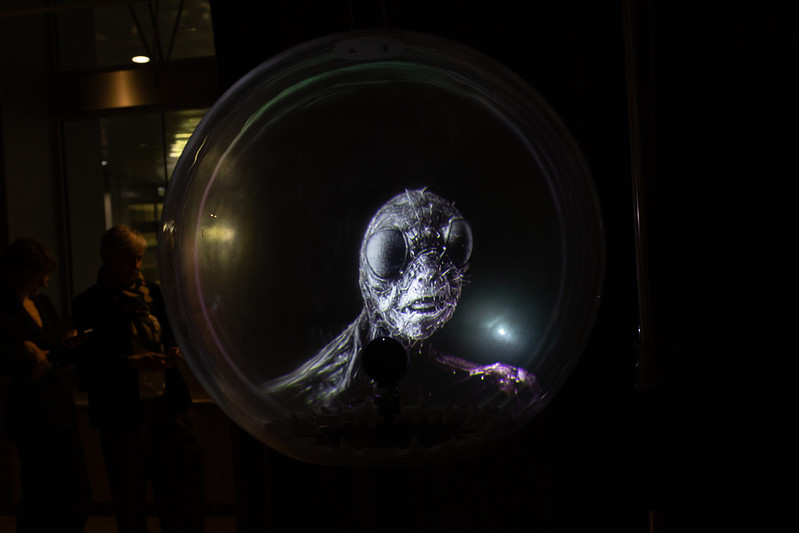
Laura Beloff & Jürgis Peters, A Black Fly / Mäkäräinen, 2026
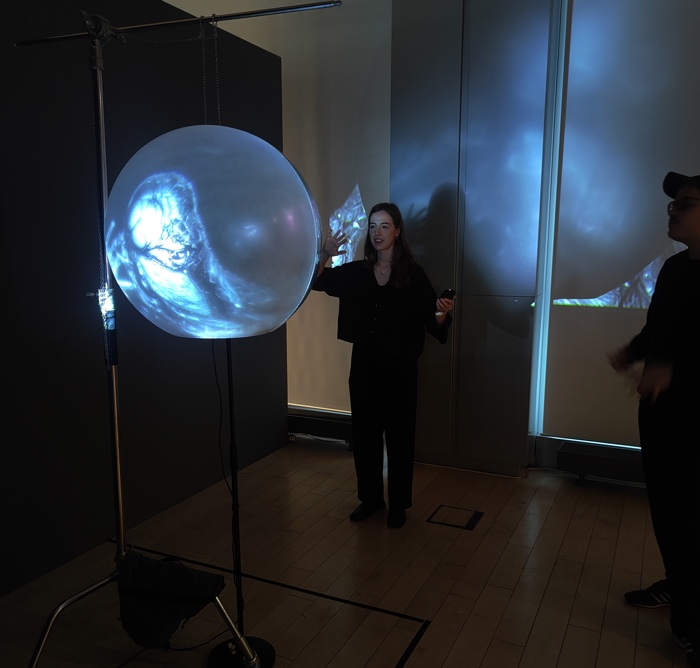
Laura Beloff & Jürgis Peters, A Black Fly / Mäkäräinen, 2026
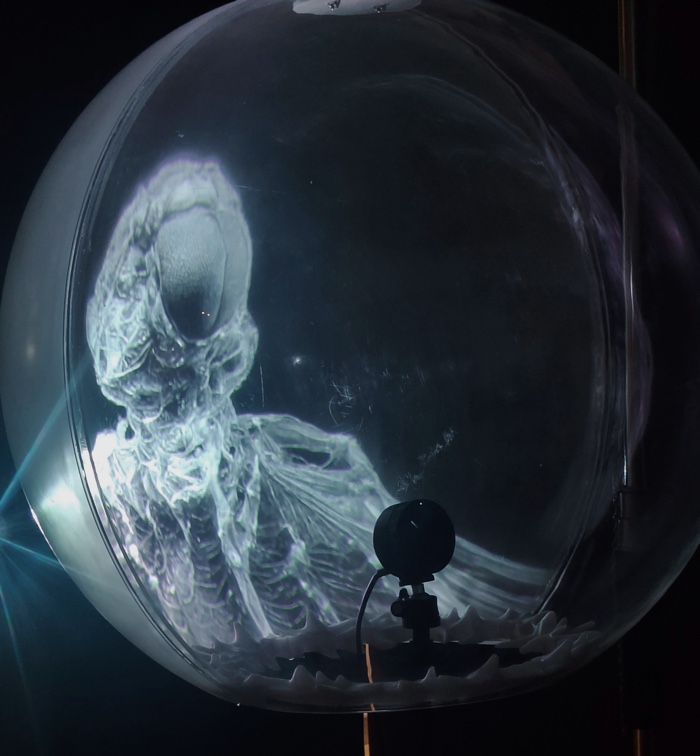
Laura Beloff & Jürgis Peters, A Black Fly / Mäkäräinen, 2026
Opening of the RIXC festival 2026 exhibition: CLIMATE IMAGINATION. Photo by Elizabete Ezergaile
Laura Beloff & Jürgis Peters, A Black Fly / Mäkäräinen, 2026. RIXC festival 2026 exhibition: CLIMATE IMAGINATION. Photo by Elizabete Ezergaile
Laura Beloff & Jürgis Peters, A Black Fly / Mäkäräinen, 2026. RIXC festival 2026 exhibition: CLIMATE IMAGINATION. Photo by Elizabete Ezergaile
Blackflies (Simulium spp.) are not particularly popular. Their blood-sucking habit make them vectors of pathogens that can affect the health of humans and other animals.
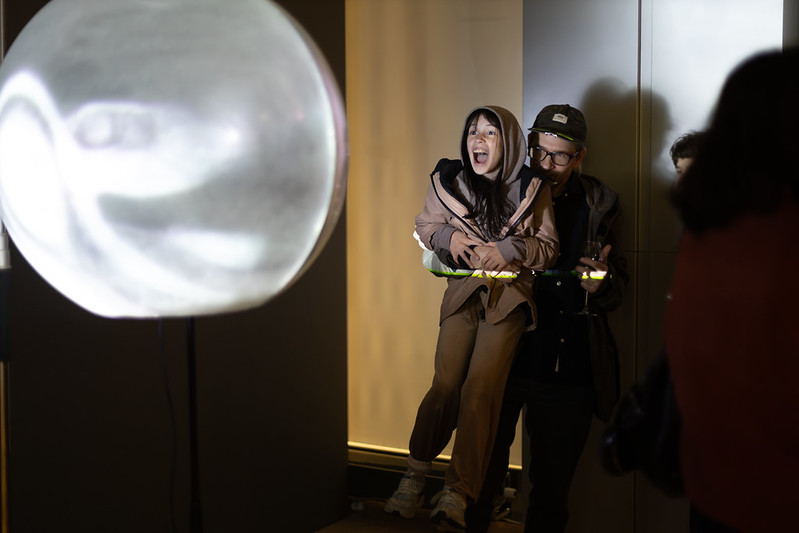
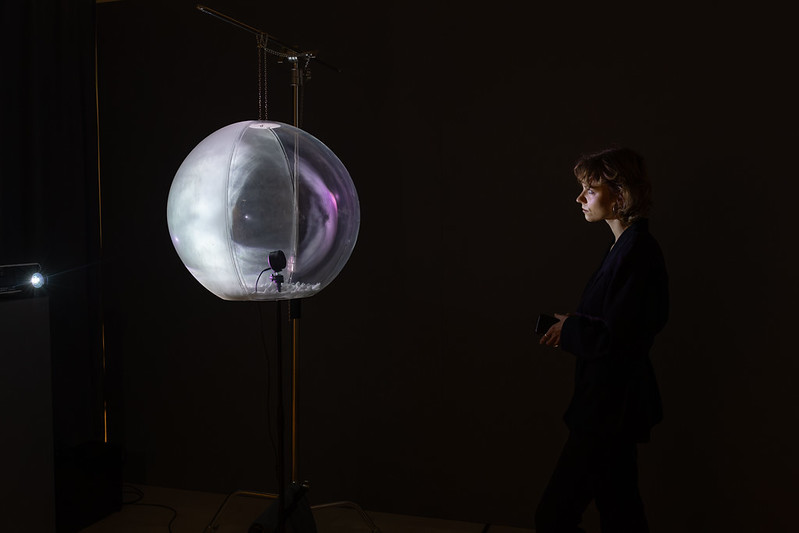
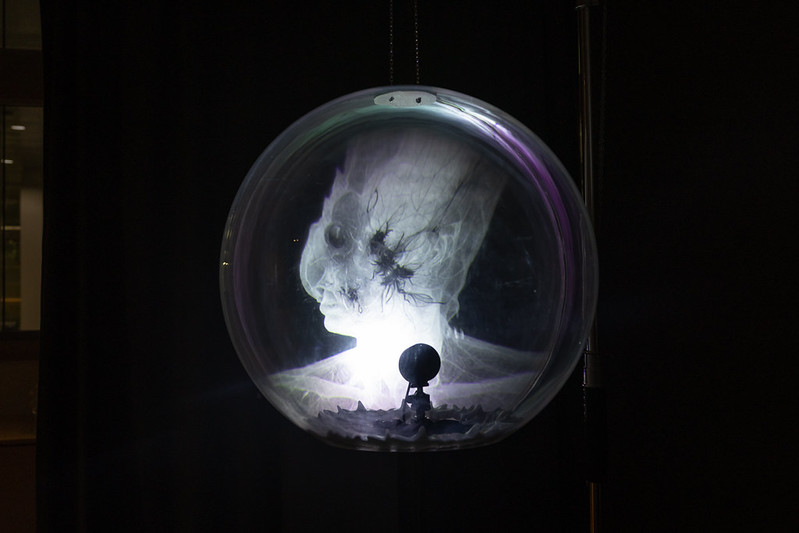
One of my favourite works in the show was The Black Fly, an installation that turned visitors into the fearsome insects. I loved it because it brought to mind David Cronenberg’s 1986 scifi movie, because i loved the idea of a work with generative AI that is not sleek and pleasing but repelling and, quite simply, because it worked flawlessly.
To experience the work, you stand in front of a transparent globe that reflects your face. After a few seconds, you begin to notice how you face is morphing into the one of a fly. Wave your hands in front of the globe and you have fly front legs and claws. It’s truly horrible.
This AI-generated video work plays with the boundary between the real and the artificial, urging visitors to consider their own hybridity; being partly organism, partly data, that are today increasingly entangled. In this installation, the black fly is no longer just an insect. It is a technological mutation of a real creature, generated by a machine trained to imitate life and evolution.
The installation makes you experience artificiality as a process, suggesting that reality is never stable but evolving and our future is possibly recombinant. The work also hints at new possibilities for kinship: relationships grounded not in empathy or likeness, but in our entanglement within biotechnological ecologies, however unpleasant they might be.
Benedikt Terwiel, ANOHNI, Land before Last (trailer)
Benedikt Terwiel in collaboration with ANOHNI, Land before Last, 2024/2025. RIXC festival 2026 exhibition: CLIMATE IMAGINATION. Photo by Elizabete Ezergaile
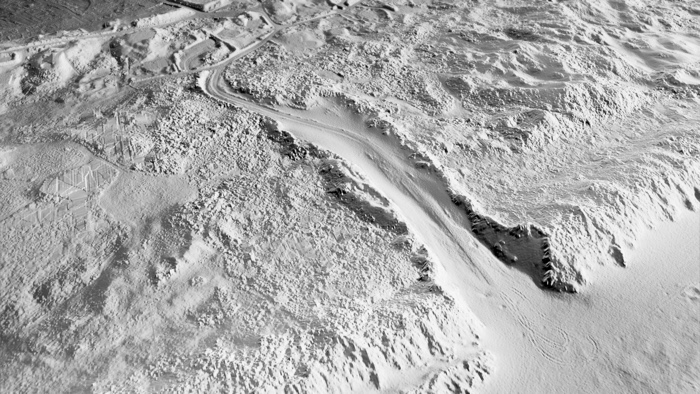
Benedikt Terwiel in collaboration with ANOHNI, Land before Last (film still), 2024/2025
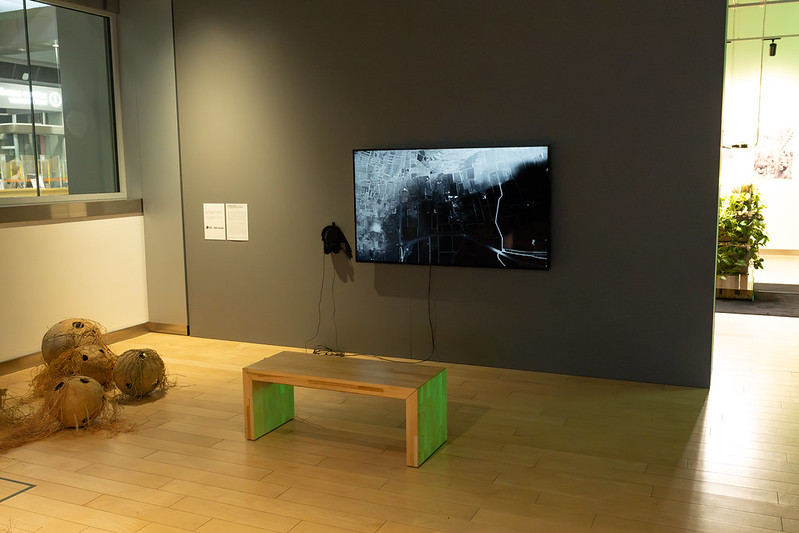
Land before Last takes us to a landscape that is grey, sterile and sinister. Benedikt Terwiel’s film unfolds within a digital terrain model created from land survey data provided by the Dutch National Topographic Institute. We are somewhere in the Netherlands, but all traces of human development and other forms of life have been erased from the topographical data.
It looks like the archaeological site of a bleak future. All there is to see are the hideous scars of human activities on the land. If i sound a little melodramatic, it’s because the images of this film still haunt me. The complete emptiness leaves us with a land that defies recognition.
The Netherlands has one of the world’s most extraordinary histories of human-made landscape transformation. For centuries, the Dutch have reclaimed land from the sea to create entirely new territories that people could inhabit and cultivate. Yet none of this long history of carefully engineered landscapes and technological infrastructure can be deciphered in the film’s images. The terrain is mute.
A voice guides us through the landscape, inviting us to reflect on the imprint of the Anthropocene on the planet.
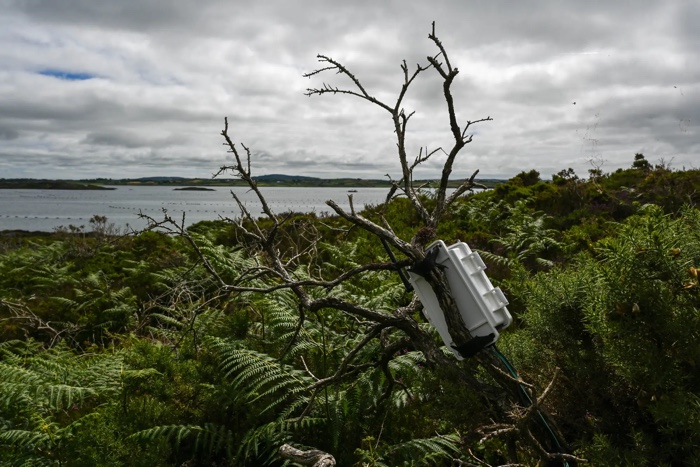
Marcus Maeder, Imeall an chosta. A coastal listening post (Measurement instruments), 2022/2026
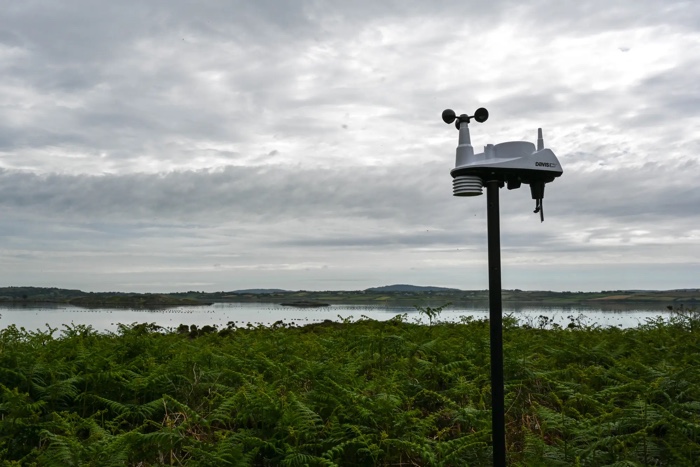
Marcus Maeder, Imeall an chosta. A coastal listening post (Measurement instruments), 2022/2026
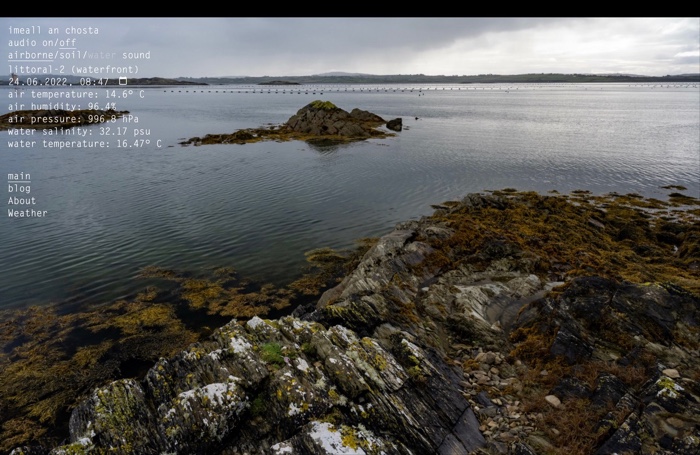
Marcus Maeder, Imeall an chosta. A coastal listening post, 2022/2026
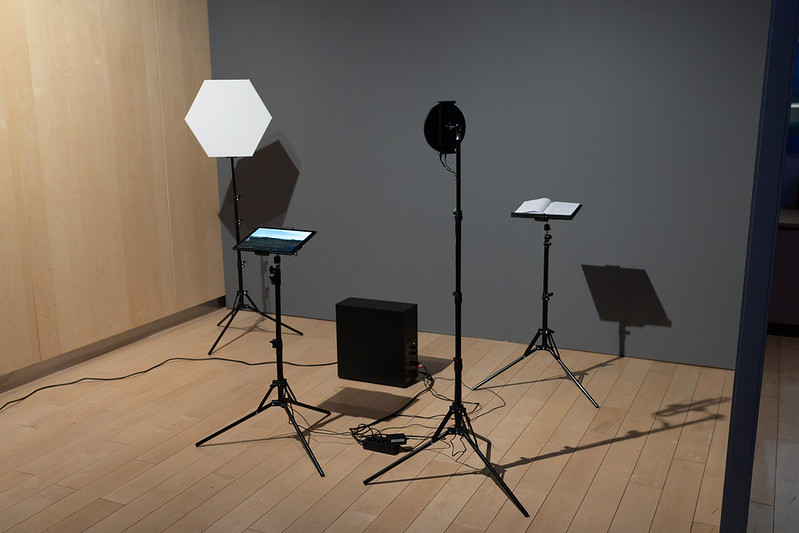
Marcus Maeder, Imeall an chosta. A coastal listening post, 2022/2026. RIXC festival 2026 exhibition: CLIMATE IMAGINATION. Photo by Elizabete Ezergaile
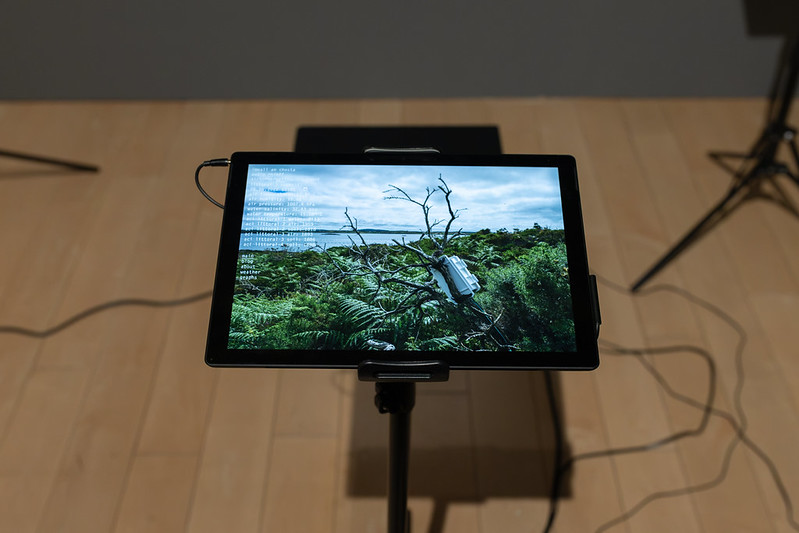
Marcus Maeder, Imeall an chosta. A coastal listening post, 2022/2026. RIXC festival 2026 exhibition: CLIMATE IMAGINATION. Photo by Elizabete Ezergaile
Climate scientists warn that the Gulf Stream’s Atlantic Meridional Overturning Circulation (AMOC) has grown increasingly unstable. A vast system of ocean currents that includes the Gulf Stream, the AMOC is becoming increasingly unstable. It transports warm tropical waters northwards towards Europe and the Arctic, helping to moderate temperatures across the region. A significant weakening or collapse could shift the tropical rainfall belt on which millions of people depend for agriculture, bring colder winters, more intense storms and drier summers to Europe, and contribute to an additional 50–100 cm of sea-level rise along Atlantic coastlines.
Under such a scenario, Ireland, for example, could experience winter temperatures comparable to those of Toronto.
Marcus Maeder‘s project Imeall an chosta (Irish for “Coastline”) investigates how these climatic changes might affect the fauna in the water and on land along the West Cork’s coast of Ireland.
The artist placed automatic recorders across the transition zone from land to sea, documenting at intervals the local microclimatic conditions as well as the soundscape over the air, underwater and soil. The collegted data was then analysed via the Acoustic Complexity Index for their acoustic diversity. The index helps researchers quantify biological sounds, such as birdsong and insect calls, while minimising the influence of continuous background noise, including wind and traffic.
The artist also set up a web radio conceived as an acoustic public observatory for the community of Ballydehob. Its interface allows visitors to navigate between different recording locations, ecological transition zones (ecotones) and periods of time, exploring the coastal ecosystem through sound. In doing so, the project makes environmental changes perceptible while creating opportunities for local dialogue about the future of the coastline.
By translating environmental measurements into an evolving soundscape, Imeall an Chosta makes changes in biodiversity and local climatic conditions accessible to a wider public, connecting the ecological consequences of a potentially weakening AMOC to the lived experience of a particular coastal landscape.
Ryu Furusawa, Mid Tide #3 Rendering System
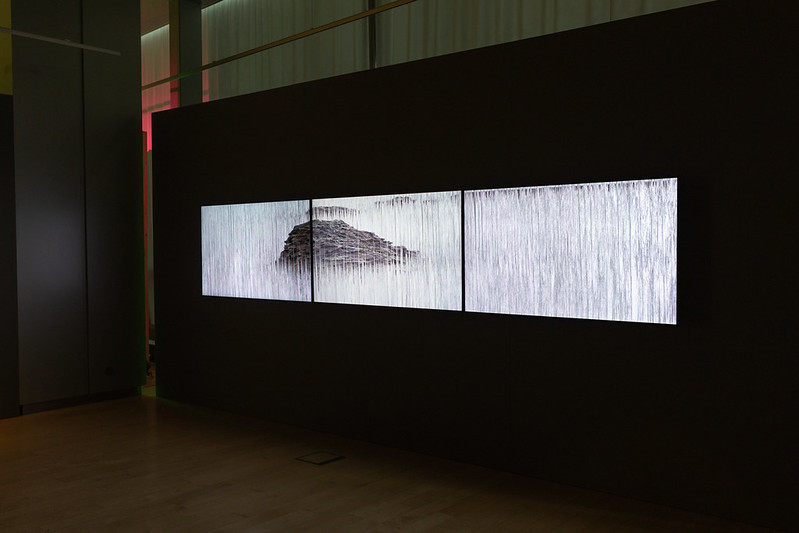
Ryu Furusawa, Mid Tide #3, 2024. RIXC festival 2026 exhibition: CLIMATE IMAGINATION. Photo by Elizabete Ezergaile
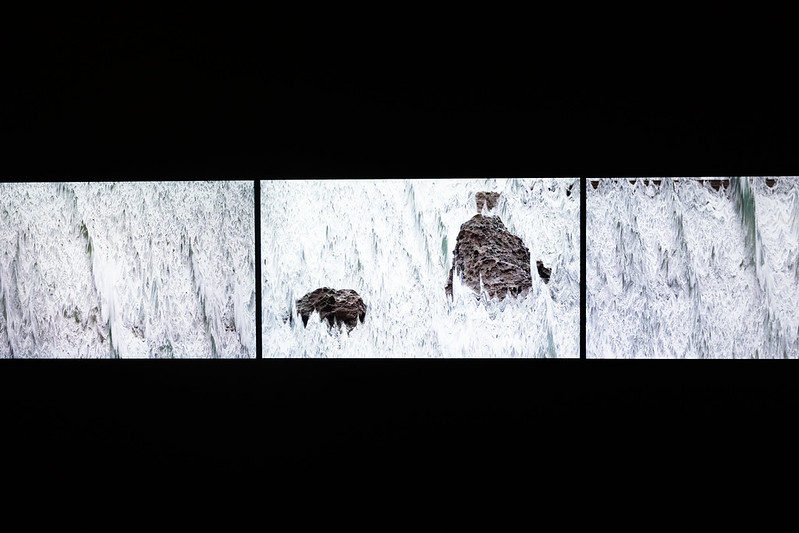
Ryu Furusawa, Mid Tide #3, 2024. RIXC festival 2026 exhibition: CLIMATE IMAGINATION. Photo by Elizabete Ezergaile
All of the above was a bit ominous so I’ll end this review of the exhibition with a work that is pure poetry.
Mid Tide #3 invites viewers to contemplate ocean waves as a movement that is continuous in both space and time. Ryu Furusawa used custom-made software to turn footage of waves breaking against the rocks of Japan’s Pacific coast into a three-dimensional structure in which time becomes the depth dimension, revealing the slow shifts of light and tide that the eye usually overlooks.
The video above explains better than I ever would how the film was made.
The installation unfolds across three large LED displays. The footage captures a real seascape from a fixed viewpoint over an extended period. Furusawa approaches video as a sequence of continuous still images, treating each frame as a separate layer that is stacked in depth to form a three-dimensional structure. In this way, time is translated into space.
In conventional video playback, time unfolds as a linear progression. Furusawa, however, presents multiple cross-sections simultaneously. Rather than simply showing time passing, the work introduces a new axis of change, in which temporal movement becomes spatial transformation.
The artist also draws a connection between this way of experiencing the sea and the experience of surfing. Out at sea, our perspective is no longer fixed, like it is when we are standing on a beach; we are immersed in the movement of the water. To catch a wave, surfers must sharpen their physical senses until their bodies seem to become one with it. Furusawa’s work seeks to evoke this same sense of immersion and unity.
The exhibition Climate Imagination was curated by Raitis Smits. It remains open at the National Library of Latvia in Riga until 12 December 2026
Previously: RIXC. Climate Imagination: multispecies conviviality.