AI’s unrestrained expansion is shaping geopolitics, disrupting local communities and accelerating the depletion of natural resources. How exactly does technology facilitate forms of human and environmental exploitations we once believed were confined to history? What does algorithmic vision reveal (or obscure!) about our understanding of the world? And in this persistent state of polycrisis, what happens to traditional systems of thought?
More importantly, do we still have agency? Can we resist societal alienation and the unchecked commodification of both people and nature?
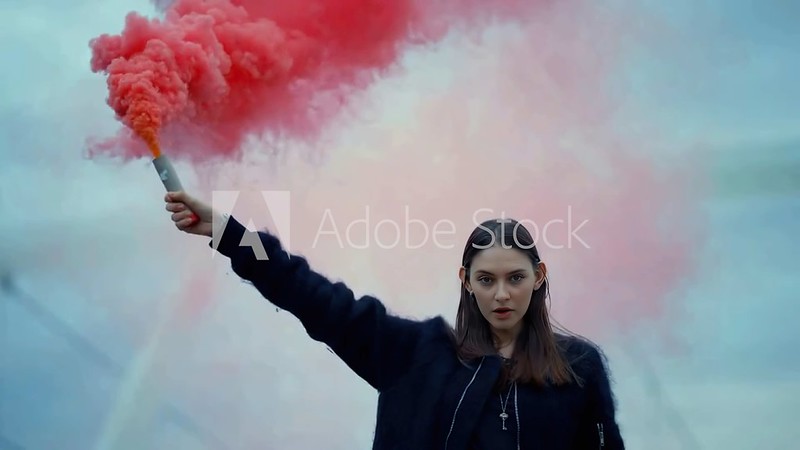
Juan Obando, They/Them, 2023. Film still
These questions lie at the heart of collapse: data.models.worlds. The exhibition, which opened earlier this month in Athens, examines the escalation and multiplication of crises shaping the contemporary world, with a critical focus on technology’s key role.
Curated by Katerina Gkoutziouli and Daphne Dragona, the show goes beyond mapping the intersections of technological infrastructures and socio-ecological collapse, it also demands new frameworks for coexistence, knowledge and responsibility.
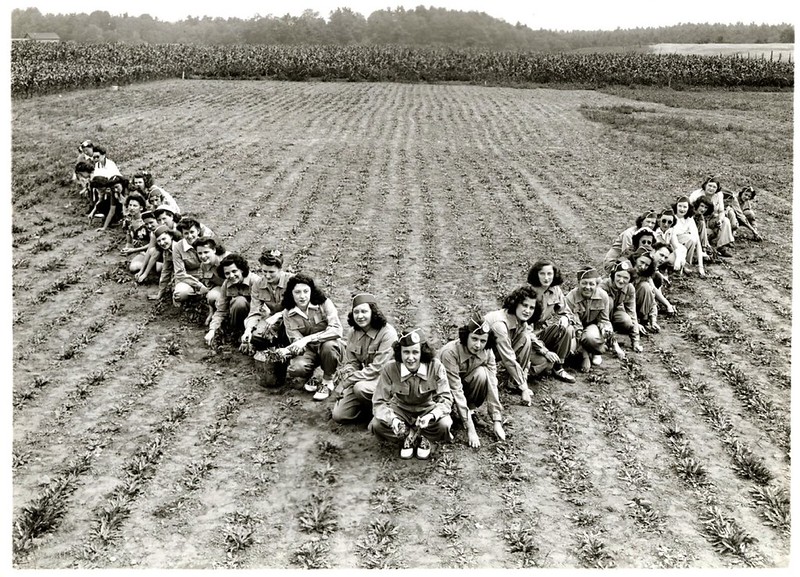
Bethan Hughes, An Elastic Continuum VI, 2025
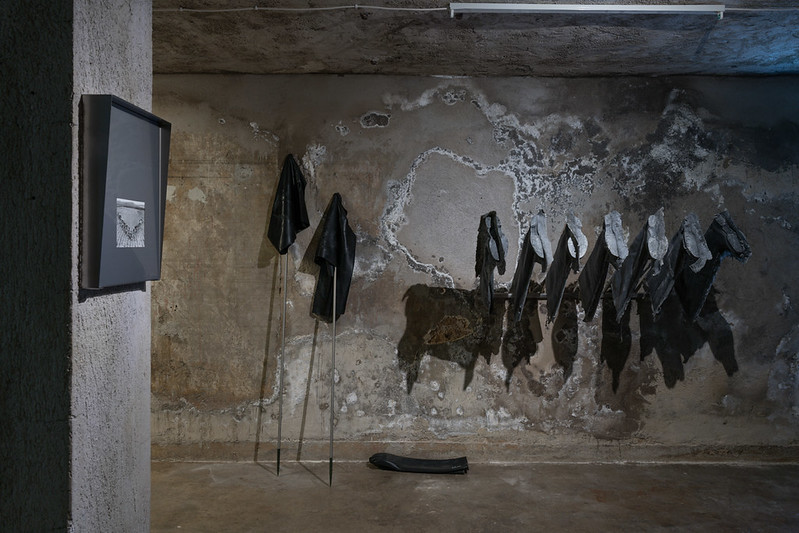
Bethan Hughes, An Elastic Continuum VI, 2025. Silver gelatin print, stainless steel, 30 x 40 cm & An Outfit for a Woman in a Field II, 2025. Latex, stainless steel, dimensions variable. Installation view. Photo: Maria Mavropoulou
I reached out to Katerina and Daphne to see if they’d be available for a conversation about how the artists in the show weave together myth, lived experience and speculative futures to reimagine our shared responsibility during this time of alarming changes.
Hi Daphne and Katerina!The general theme of collapse: data.models.worlds is fairly dark. The exhibition explores “how technology (and in particular the growing implementation of AI in all sectors of society) “promises solutions that are inextricably linked to mechanisms of exploitation of human and natural resources.” Yet, I think that you and the artists try to go beyond the sense of doom and gloom that the topic suggests. How does the exhibition balance this sense of anguish and helplessness? How does it, as you beautifully explain, “create the ground for a discussion around the restoration and preservation of social and environmental balance”?
Daphne Dragona: We were aware that the theme and the title would be perceived as dark, as you noted. The title of the exhibition emerged after a lot of discussions between us. Initially, we were planning to focus on the impact of the prolonged, intensified, and generalized crisis. As our work progressed, we felt we needed to pay more attention to the words currently being used to describe the turning point that the world is now at. Discussions evolve around environmental collapse as we face resource depletion and species extinction, societal collapse stemming from ongoing crises, a collapse of the ‘real΄ via AI-generated content, and, last but not least, the ΄model collapse’ of computational systems learning from synthetic data. ‘Collapse΄ has increasingly entered our daily vocabulary, and we wanted to explore how these facets interconnect and relate to recurring forms of exploitation, from the past to the present.
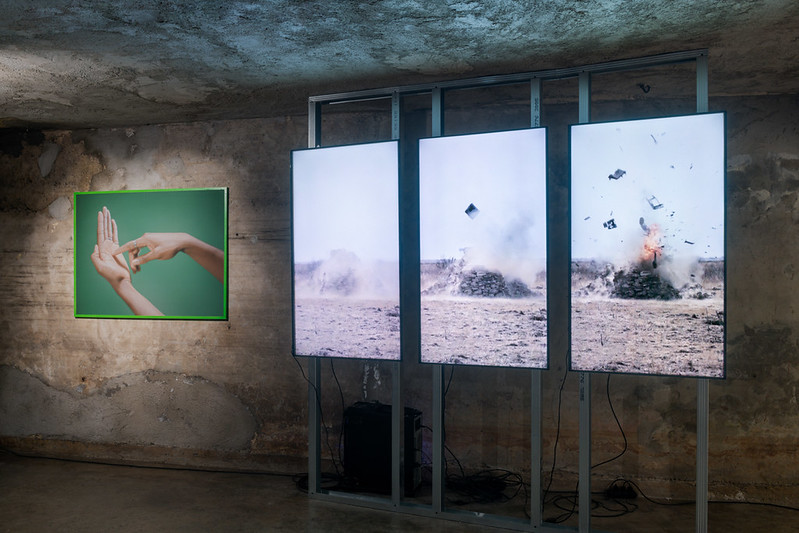
Salvatore Vitale, Death By GPS, 2023-2026. 3-channel video, color, sound, 3’40”, Inkjet print, 90 x 120 cm. Installation view. Photo: Maria Mavropoulou. collapse: data.models.worlds
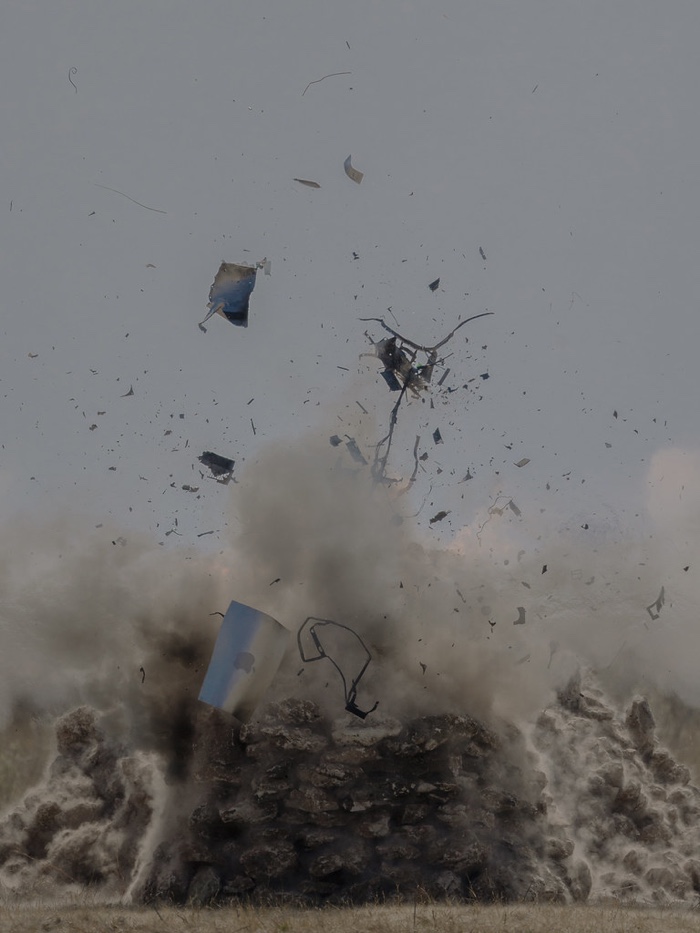
Salvatore Vitale, Death By GPS, 2023-2026. Film still
Through the works presented, we aim to make these interconnections clear while highlighting the urgent need to rediscover agency, ways to act. The projects manifest symbolic or actual forms of resistance and restoration. For instance, Salvatore Vitale’s Death by GPS investigates digital labor exploitation in South Africa while claiming a right to pause, to reflect upon precarity, to withdraw, and regain time. Beth Hughes’ work on natural rubber exploitation illustrates how the lives of workers and plants are interwoven, as well as how forms of resilience and resistance can emerge from that very interdependence.
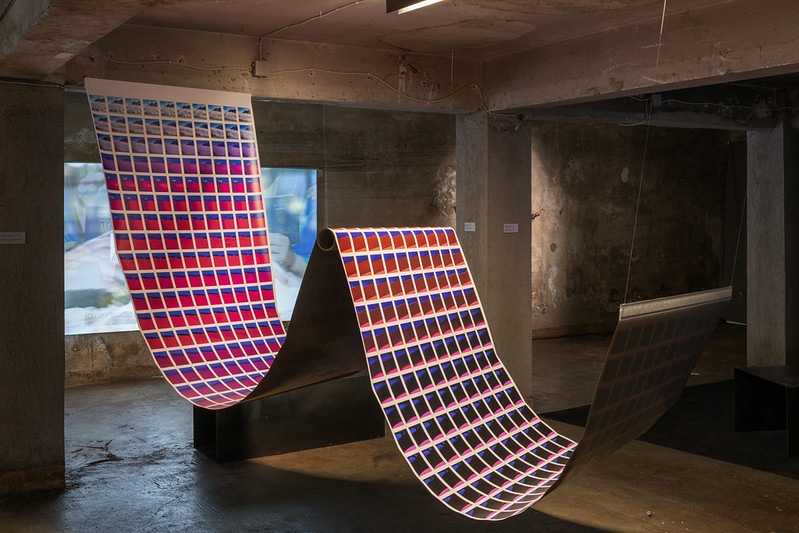
Maria Mavropoulou, Ecologies of Noise, 2026. Digital print, 100 x 500 cm. Installation view. Photo: Maria Mavropoulou
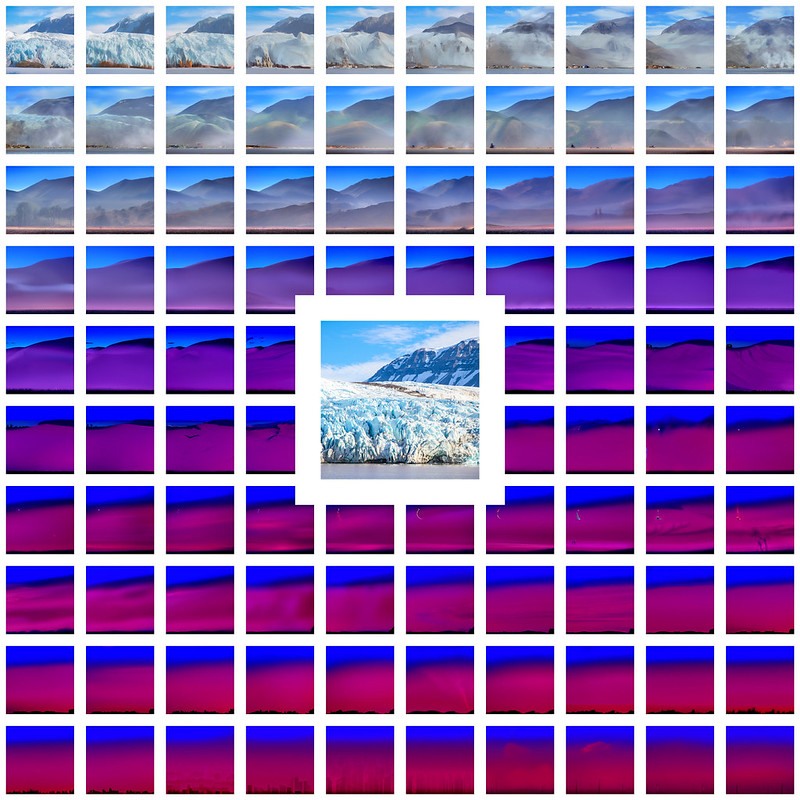
Maria Mavropoulou, Ecologies of Noise, 2026. Detail
The exhibition features works by Maria Mavropoulou, Athina Koumparouli, Niki Danai Chania and Latent Community. I was not familiar with their practice, but I had a look at their websites and they all work on very interesting ideas and topics. Could you say a few words about the pieces they are showing in the exhibition?
Katerina Gkoutziouli: All of them are artists based in Greece, and while some works were created specifically for the exhibition, others emerged from new projects they were already developing that felt very relevant to the exhibition theme. So, we are pleased to be presenting these works for the first time.
Maria Mavropoulou presents a part of her new project entitled Ecologies of Noise, in which she exposes the phenomenon of model collapse, by using custom-made software developed to work with an image-to-image AI generator. Feeding the AI generator with Creative Commons licensed images depicting some of the most endangered ecosystems, and then repeatedly using each generated output as the next input, Mavropoulou examines the gradual degradation of the image and the landscapes depicted, as they dissolve into a minimal color field. Through this recursive process, the work reflects on the one hand, on the aftermath of the extraction and exhaustion of natural resources, and on the other, on how AI systems trained on synthetic material can lose their connection to reality. This results in what Mavropoulou describes as “end images: the exhausted remains of a process that has consumed its referent”, pointing to the limitations of algorithmic vision and processes of cultural homogenisation.
Strata of Cloud to Ground is a new work by Athina Koumparouli, which takes the form of a sculptural installation composed of relics of LCD screens that evoke both technological ruins and geological formations. Layered fragmented displays and etched surfaces suggest the material afterlives of digital culture, highlighting the environmental and temporal costs embedded within seemingly immaterial systems. The installation frames contemporary devices as tomorrow’s ruins, imagining them as future artefacts that will be excavated, and reinterpreted within narratives of technological progress and decline.
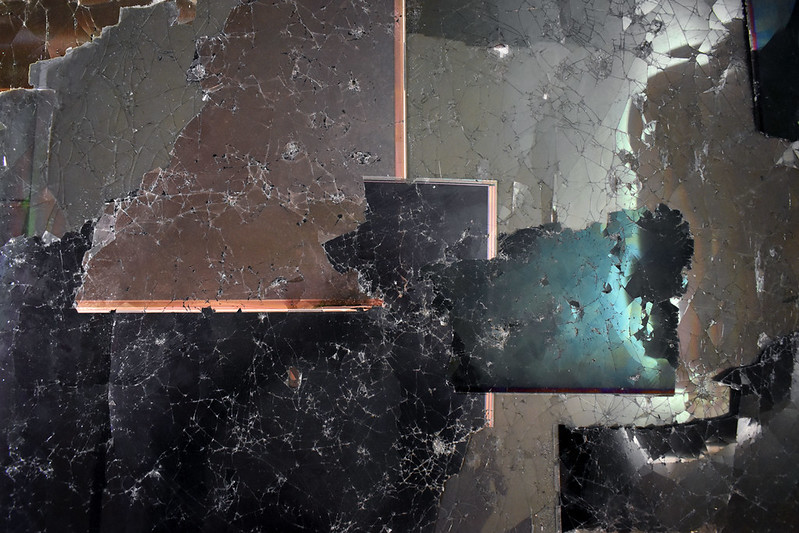
Athina Koumparouli, Strata of cloud to ground, 2026. Detail
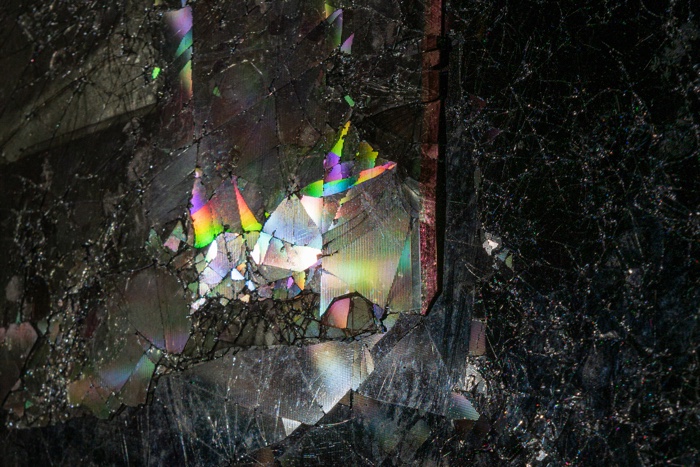
Athina Koumparouli, Strata of Cloud to Ground, 2026. Detail. Photo: Maria Mavropoulou
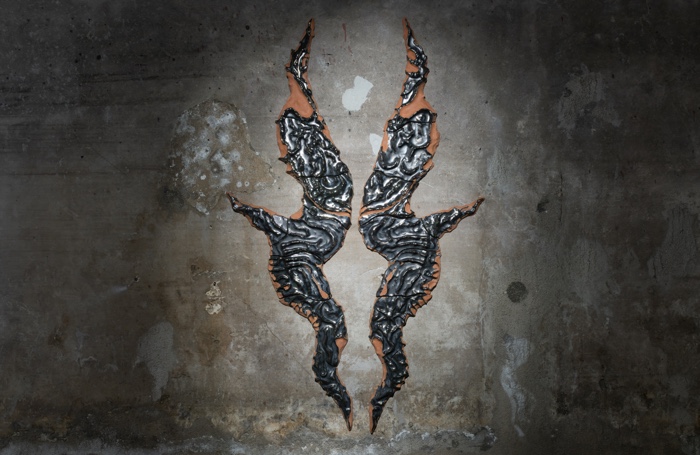
Niki Danai Chania, The Nymph (Fragment of), 2026. Installation view. Photo: Maria Mavropoulou
Niki Danai Chania showcases The Nymph (Fragment of), a ceramic sculpture inspired by a semi-fictional story about a water nymph forced to abandon her underwater home after its destruction by industrial violence, relocating instead to crisis-era Athens. Engaging with the ongoing crises in urban environments, Chania examines the concept of monstrosity and displacement through myth and symbolism. Living in the centre of Athens, the fragmented figure appears to evolve through a silvered surface, evoking the fluid nature of water, a force which can carry the debris of a city, both literally and metaphorically.
Latent Community, an art duo composed of visual artists Sotiris Tsiganos and Ionian Bisai present Dark Source: Cloud Extraction. The work is a video essay addressing the social and ecological impacts of lignite extractive practices in the villages of Western Macedonia as well as the region’s potential transformation from extractive landscapes into sites for data center infrastructure. Combining speculative narration with local histories and environmental research, their work approaches extraction as an ongoing process of transformation that affects land, water, and communities while reflecting on the relationships between humans, technology, and the environment. Cloud Extraction marks the first iteration of Dark Source, an ongoing critical research project on extractivism, and we were excited to develop it through a commission by VEKTOR Athens and Error 417 Expectation Fail for this exhibition.
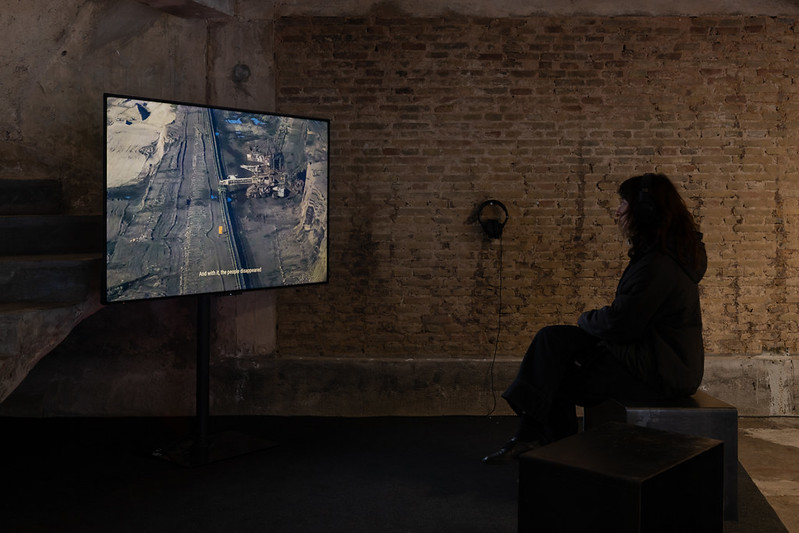
Latent Community, Dark Source: Cloud Extraction, 2026. Single channel video, stereo sound, 8’20’’. Installation view. Photo: Maria Mavropoulou
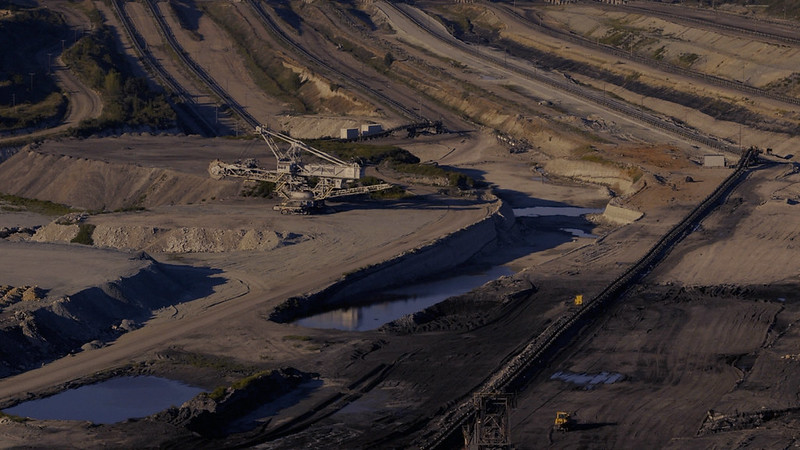
Latent Community, Dark Source: Cloud Extraction, 2026. Film still
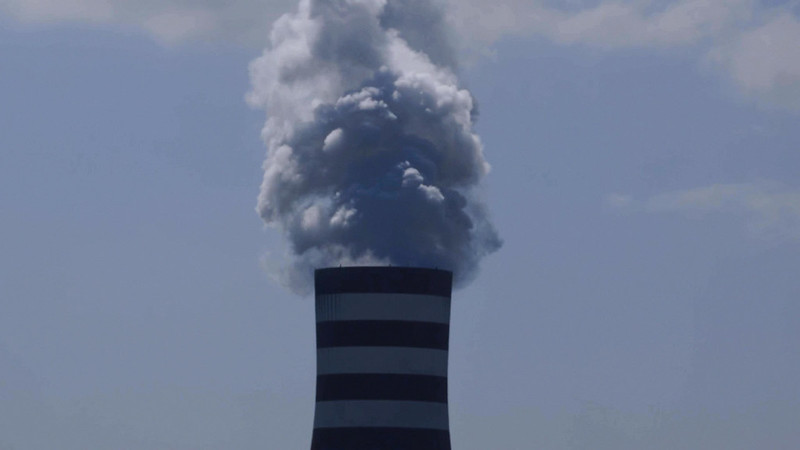
Latent Community, Dark Source: Cloud Extraction, 2026. Film still
Given the urgency and relevance of these works in the context of the exhibition, do you think artists in Athens and Greece bring a unique awareness or perspective to the detrimental impacts of AI on society, politics and the environment?
KG: I think that artists in Greece bring a particular understanding of AI’s impacts, just as artists in other countries and contexts develop their own situated practices. In Greece, this awareness is often shaped by conditions of prolonged and overlapping crises, economic precarity, fragile infrastructures, and shifting political realities.
In the case of AI, from an infrastructural point of view, Greece has only recently entered the map of large-scale technological development, as major tech companies are currently building data centres in the country with the ambition of positioning it as a central node in Southeast Europe. For example, the new work by Latent Community directly addresses this transformation and more specifically how the lignite-based extractive industry in the villages in Western Macedonia is expected to be transformed into facilities for hyperscale data infrastructures. However, beyond this work, which is more locally situated yet also resonates with what happens in similar regions around the world, the works by Maria Mavropoulou and Athina Koumparouli point to the ongoing expansion of global technological systems. Their practices address issues ranging from the environmental afterlives of digital infrastructures to processes of cultural flattening and homogenisation associated with AI. These concerns cannot be framed as specific to Greece alone. For this reason, the exhibition intentionally brings together practices from different geographies in order to highlight that critical engagements with AI are happening in many contexts and are deeply entangled.

Juan Obando, They/Them, 2023. Installation view. Photo: Maria Mavropoulou
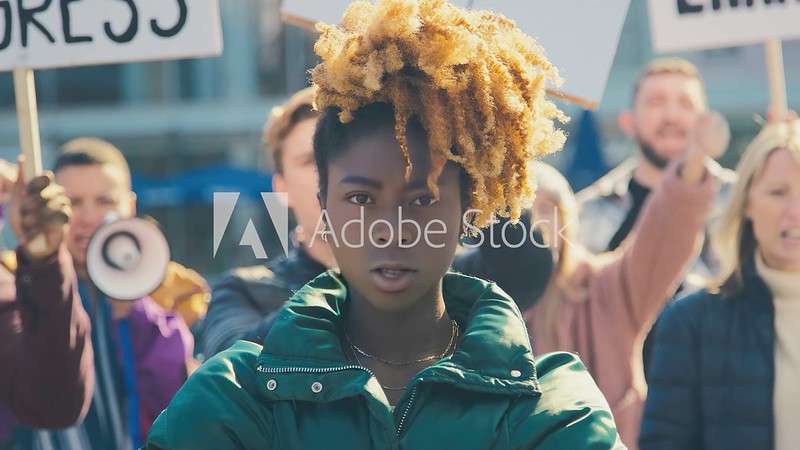
Juan Obando, They/Them, 2023. Film still
Technology is relentlessly sold to us as the solution to pretty much every problem under the sun, from ocean acidification to cancer to growth in wealth inequality. How familiar do you think that we (the general public) are with the negative impact that technology and AI in particular has on the environmental and social crisis?
DD: We are constantly confronted with forms of technological solutionism, from green energy to geoengineering and AI-powered climate tools, without committing to rethinking and changing our ways of living. Although the negative impacts of technology are no longer marginal topics and most people are widely aware of them, the problem is that the use of AI now feels unavoidable, creating a sense of nothing left to be done. From the Big Tech companies backsliding on carbon emission commitments to users no longer attempting to mitigate their AI use, it all starts to look like an impasse. Also, there is a growing exhaustion in trying to discern what is real, and what is not and what we should still believe in. We have reached a point where we start discussing what is free from AI…
In the exhibition, Juan Obando’s work provides a poignant commentary on this, questioning the future of resistance when even demonstrations can be staged to become content for stock videos, responding to the demand for content. What does this mean for future activism? How does manufactured content affect our ability to evoke genuine change? New challenges keep emerging that one needs to become aware of, to understand, and address. And, as we also try to underline through our show, the problem is that challenges in the technological, ecological and societal sphere are interrelated. There is a constant urge to understand a bigger complex picture.
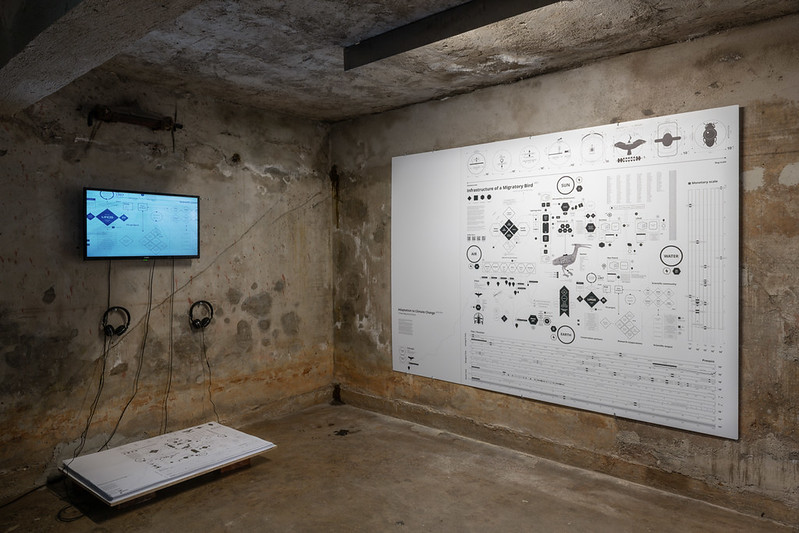
Vladan Joler/ Gordan Savičić/ Felix Stalder, Infrastructure of a Migratory Bird, v2.0, 2025. Print on Alu-dibond, 220 x 180 cm. Video, sound, 2’55’’. Installation view. Photo: Maria Mavropoulou
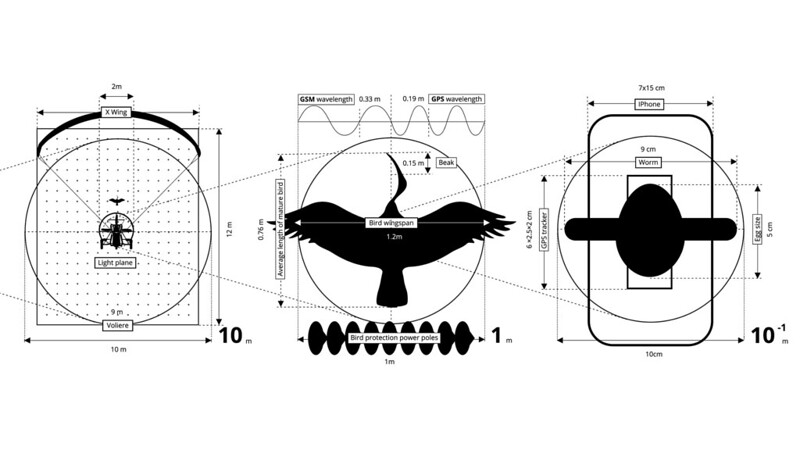
Vladan Joler/ Gordan Savičić/ Felix Stalder, Infrastructure of a Migratory Bird, v2.0, 2025. Detail
I’d love to hear your thoughts on the possible role(s) of art in fostering what you call “a shift towards new forms of coexistence, knowledge and responsibility”?
DD: As mentioned, we must find ways to reclaim our sense of agency. This is no easy task given the sovereignty of Big Tech and its pervasive models, but a technophobic rejection won’t help us either. Currently, there is a hopeful and well-grounded movement in both writing and practice toward ‘convivial’ practices and ‘relational’ technologies that move beyond asymmetrical and exploitative strategies. To a great extent, this shift involves acknowledging what no longer works in the long term, while actively reaching for what does. Thinking how technological infrastructures affect planetary ecosystems and their species is of key importance in this context.
There are inspiring examples of initiatives embracing coexistence through the thoughtful use of science and technology. Such a case is the rewilding of the Northern Bald Ibis, a migratory bird with habitats across Europe, the Middle East, and North Africa. Its story and the role technology played in its restoration has been meticulously mapped by Vladan Joler, Gordan Savičić, and Felix Stalder. Their diagram captures a beautiful, hopeful case of ecological restoration that points toward the kind of responsibility and coexistence we hope to foster.
KG: Artists today are increasingly working through the contradictions of technological systems, from AI infrastructures and ecological pressures to new mechanisms of knowledge and content production. This reflects the urgency within which the artistic community finds itself, not only to respond to the rapid transformation, but also to develop new artistic strategies, methodologies and forms of attention in order to grasp the complexity of these systems that are increasingly opaque and distributed.
AI and the technological infrastructures that sustain it are here to stay, so the role of art is more about creating critical proximity, that is, creating the conditions where these systems can be examined, experienced, and re-imagined. This is also what we attempted with the exhibition where the works move between critical analysis and speculative thinking. By staging such encounters, where the abstraction and the often-invisible costs of technology become more tangible, the exhibition invites the audience to rethink their own implication in these systems, possibly igniting new forms of coexistence, knowledge and responsibility.
Thank you Daphne and Katerina!
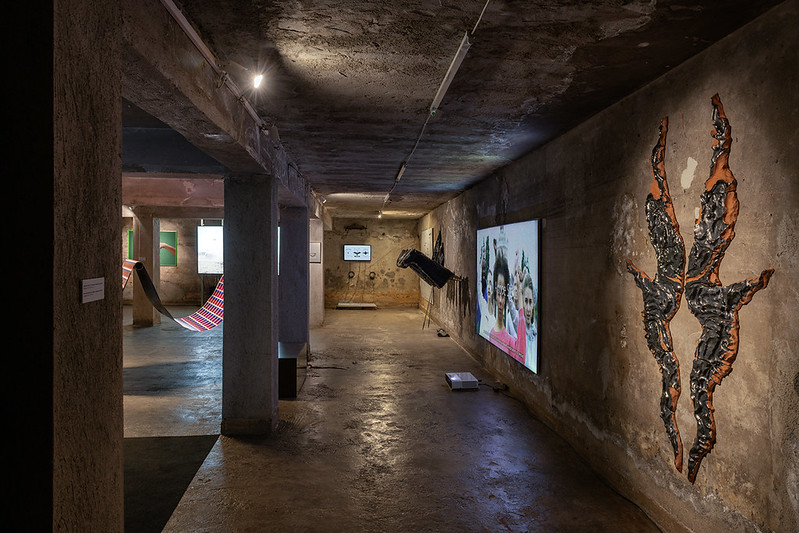
collapse: data.models.worlds. Exhibition installation view. Photo: Maria Mavropoulou
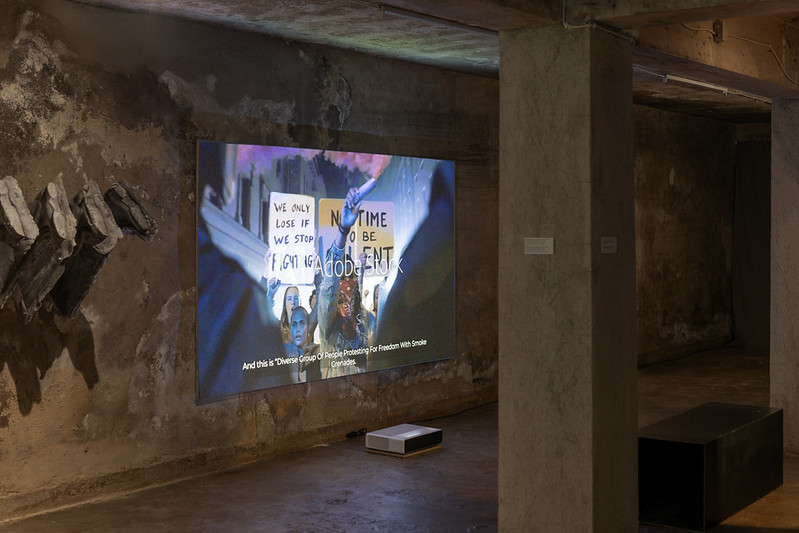
collapse: data.models.worlds. Exhibition installation view. Photo: Maria Mavropoulou
collapse: data.models.worlds., organised by Vektor Athens, is on view until 2 April at Saigon. The exhibition was curated by Katerina Gkoutziouli and Daphne Dragona.